


INTRODUCTION
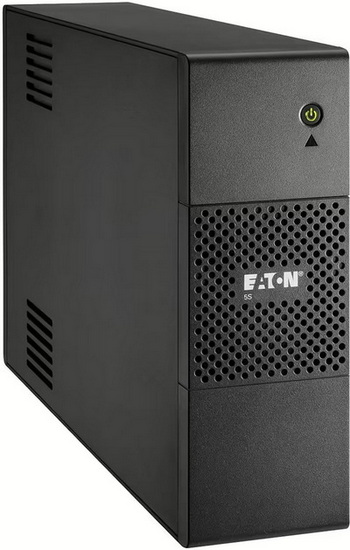
With summer already here if you happen to be living in a place where the power grid tends to "fluctuate" during this season plugging in your PC and other crucial electronics onto a good UPS is always recommended. Unfortunately, aside temperatures power demands also spike during the summer period (primarily due to increased AC use) and well, the resulting power grid problems are never a good thing for anything electronic. Eaton is among the top brands in this field and today with me I have one of their most popular models to date the 5S 1500i.
Eaton is an intelligent power management company dedicated to protecting the environment and improving the quality of life for people everywhere. We make products for the data center, utility, industrial, commercial, machine building, residential, aerospace and mobility markets. We are guided by our commitment to do business right, to operate sustainably and to help our customers manage power ─ today and well into the future. By capitalizing on the global growth trends of electrification and digitalization, we’re accelerating the planet’s transition to renewable energy sources, helping to solve the world’s most urgent power management challenges, and building a more sustainable society for people today and generations to come. Eaton was founded in 1911 and has been listed on the New York Stock Exchange for more than a century. We reported revenues of $23.2 billion in 2023 and serve customers in more than 160 countries.
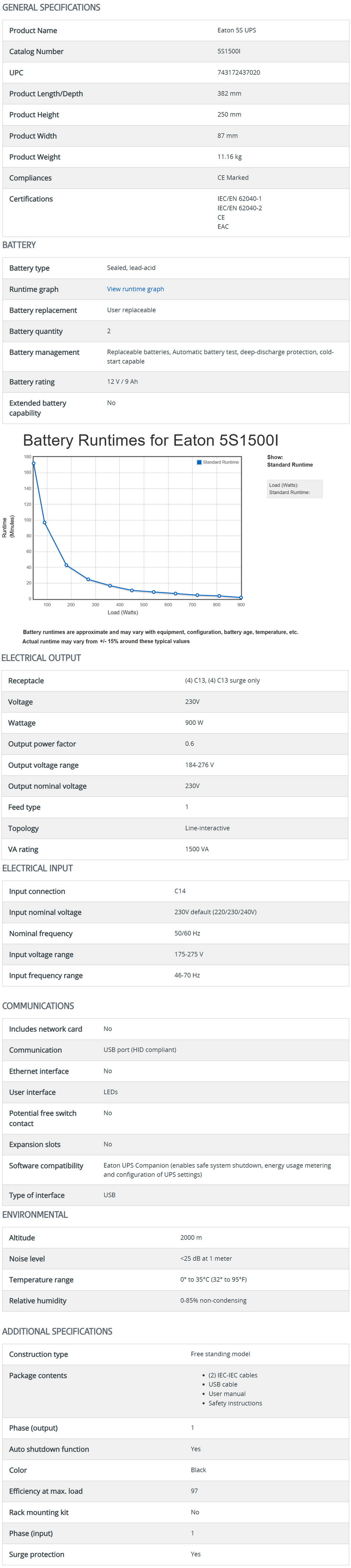
The 5S line currently includes 550/700/1000/1500VA models with and without an LCD screen (my sample doesn't have one) all of which follow the line interactive topology (AVR with Booster + Fader). Once again due to its very good automatic voltage regulation, optimal battery life and efficient power transfer the line interactive topology is 2nd best only to online (double conversion) one and so it's ideal even for sensitive electronic devices including of course PCs. The 5S series also features automatic surge reduction, auto shutdown, telephone line & modem/fax protection (two RJ11 connectors), breaker, front activity LED, horizontal or vertical placement and a HID-compliant USB host port via which you can use Eaton's UPS Companion software (enables safe system shutdown, energy usage metering and easy configuration of UPS settings). As for the 1500VA model which I have here with me supports up to 900W output, has 8 IEC C13 outlets (4 battery powered and surge protected and 4 surged protected only) and uses two 12V 9.0Ah maintenance-free sealed lead-acid batteries (deep discharge protection) easily replaceable by the end user.
SPECIFICATIONS AND FEATURES
PACKAGING AND CONTENTS
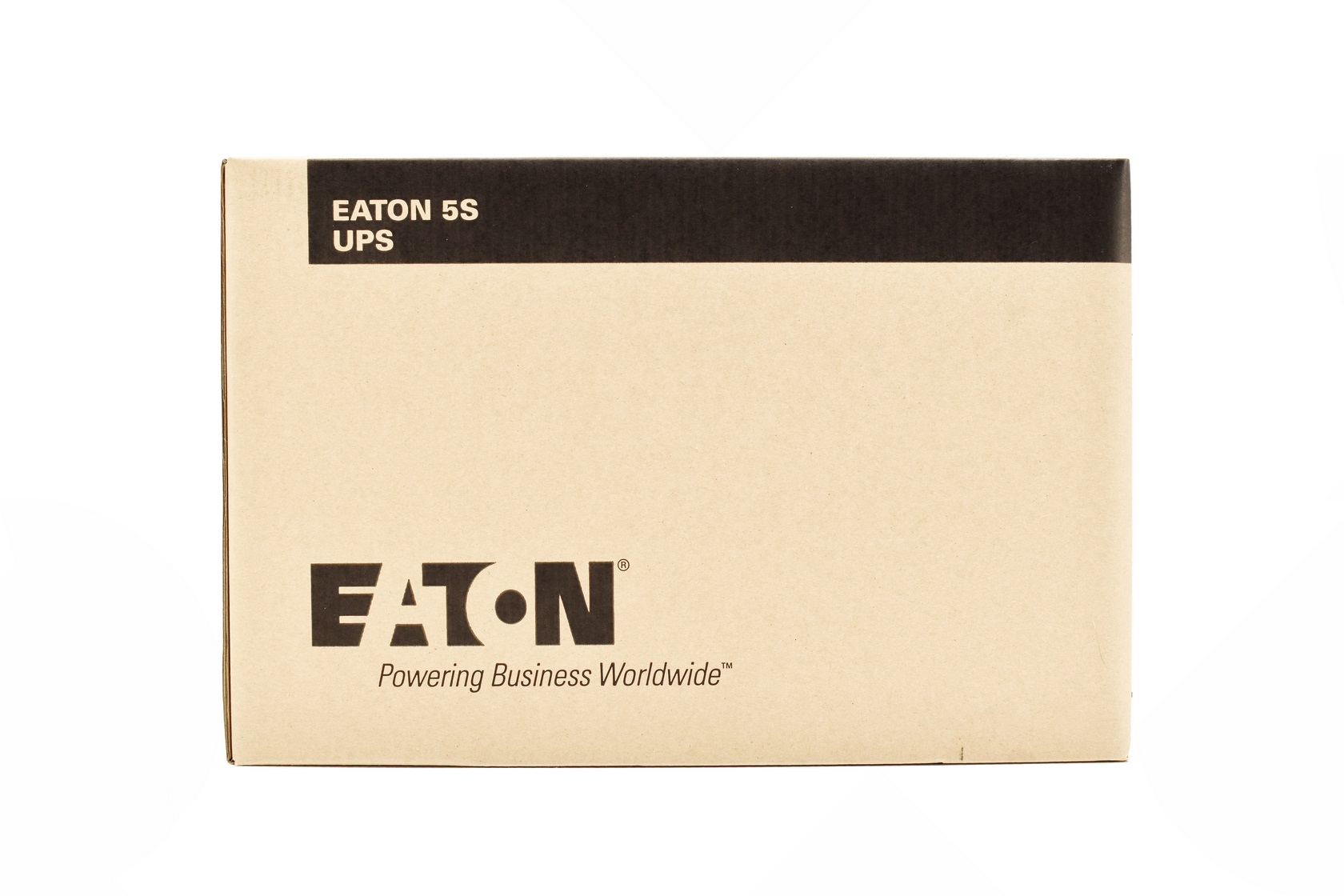
The 5S 1500i is packed inside a plain cardboard box that has the company name on all sides.

Packing is adequate with the UPS placed inside a plastic bag and between to pieces of Styrofoam.
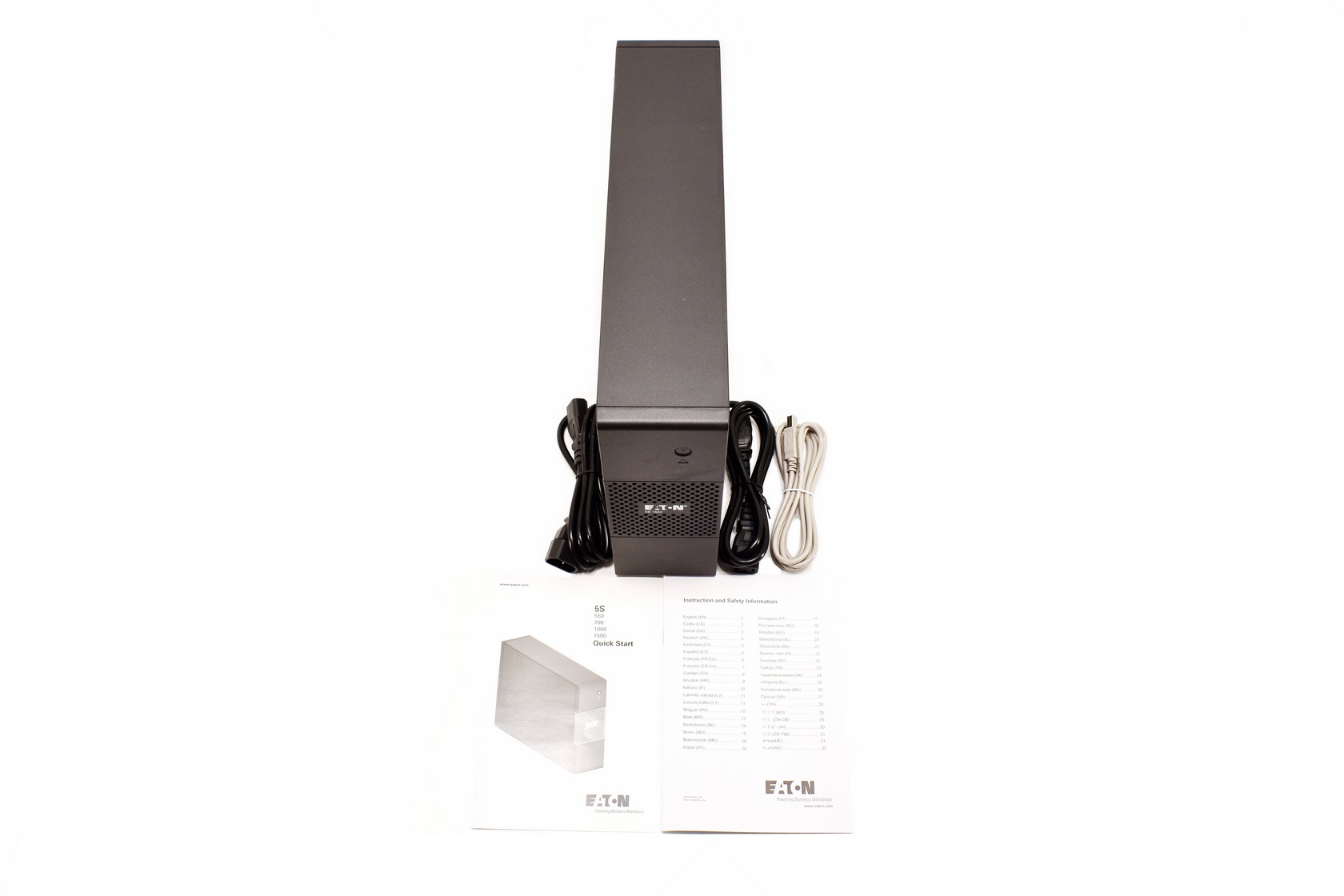
Along with the 5S 1500i inside the box you'll also find two IEC cables, USB host cable, safety and instructions paper and the quick start guide.
THE 5S 1500I
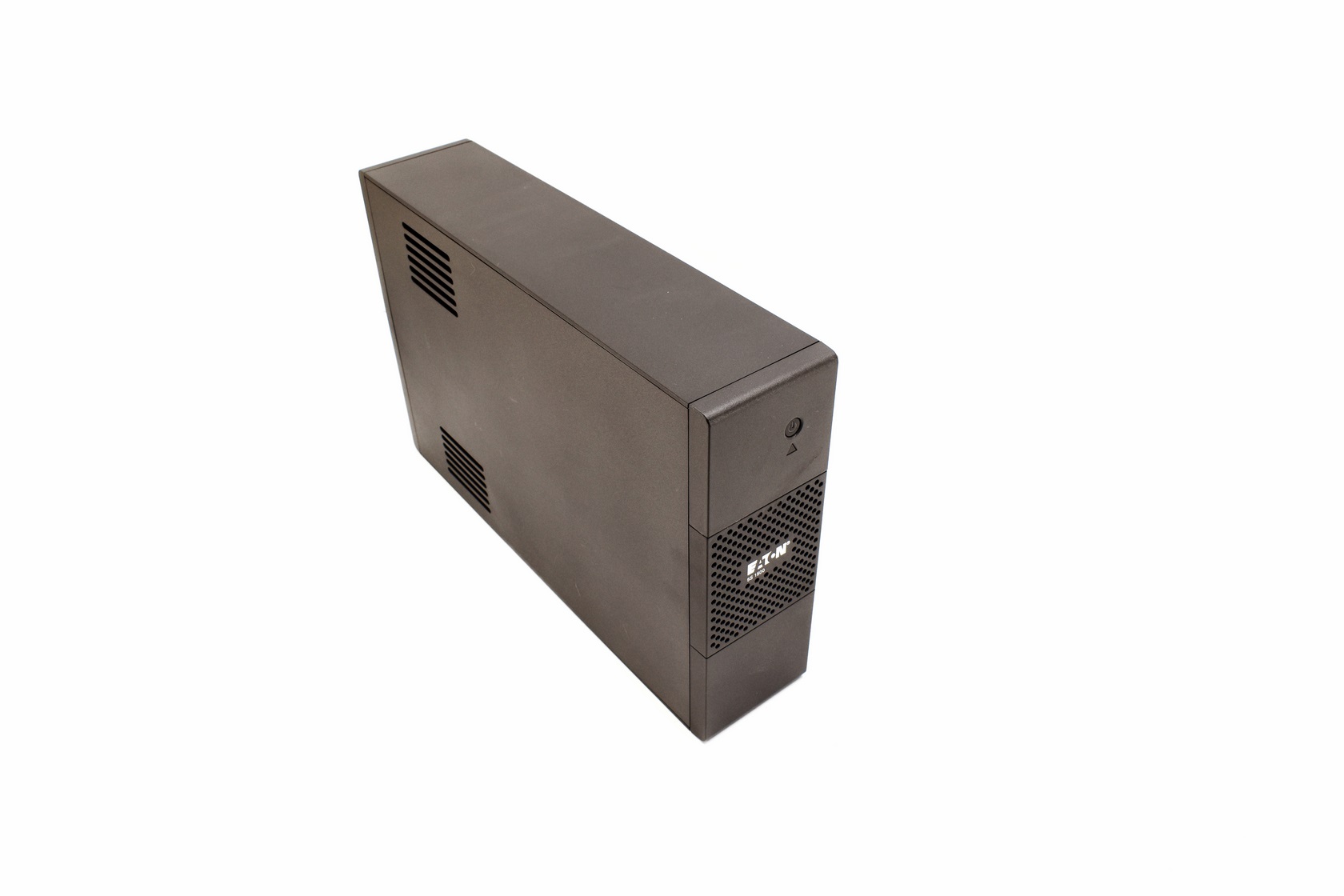
The 11.16Kg heavy 5S 1500i UPS measures 382mm in length, 87mm in width and 250mm in height.
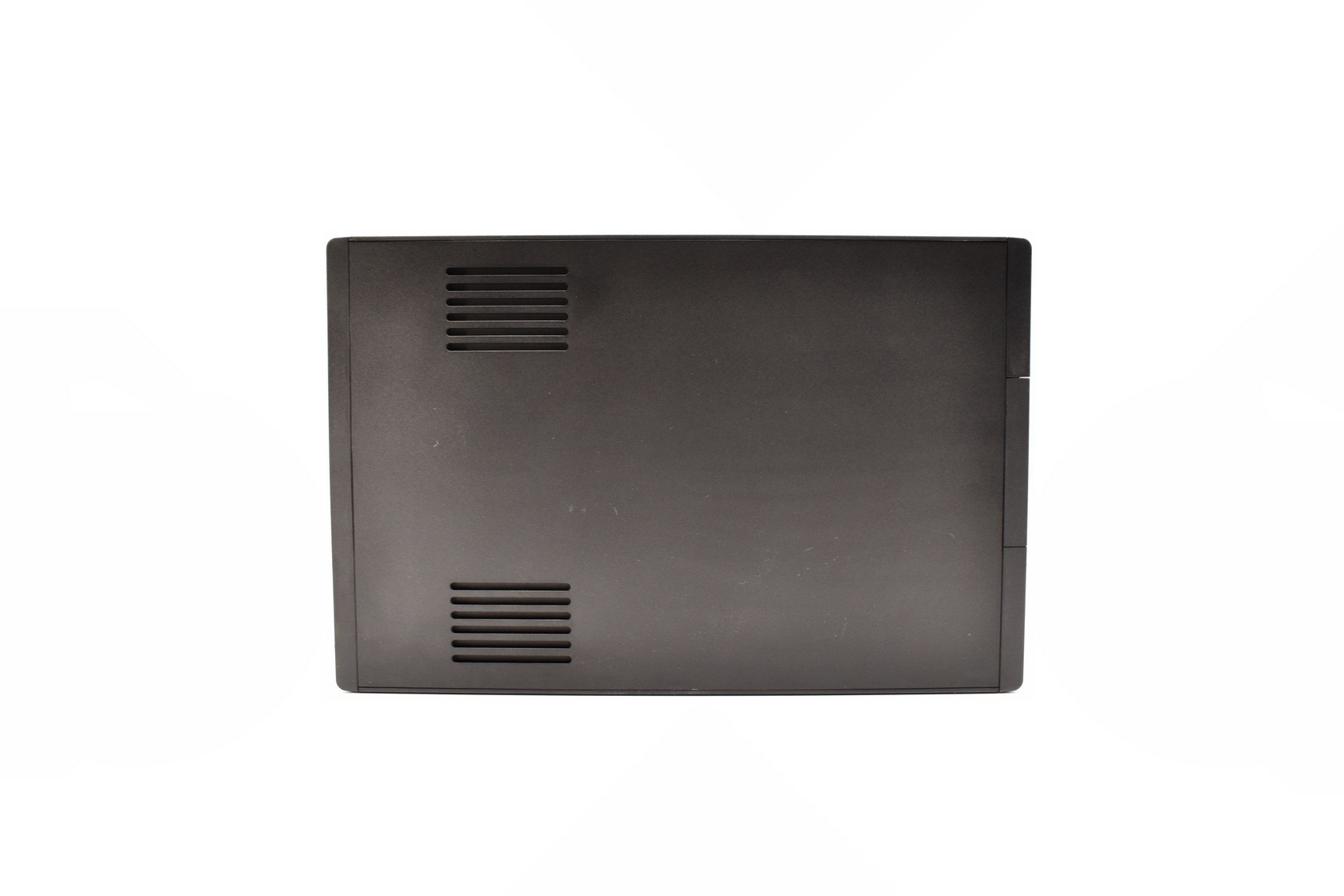
Eaton has placed vents on both sides of the 5S 1500i (actively cooled).
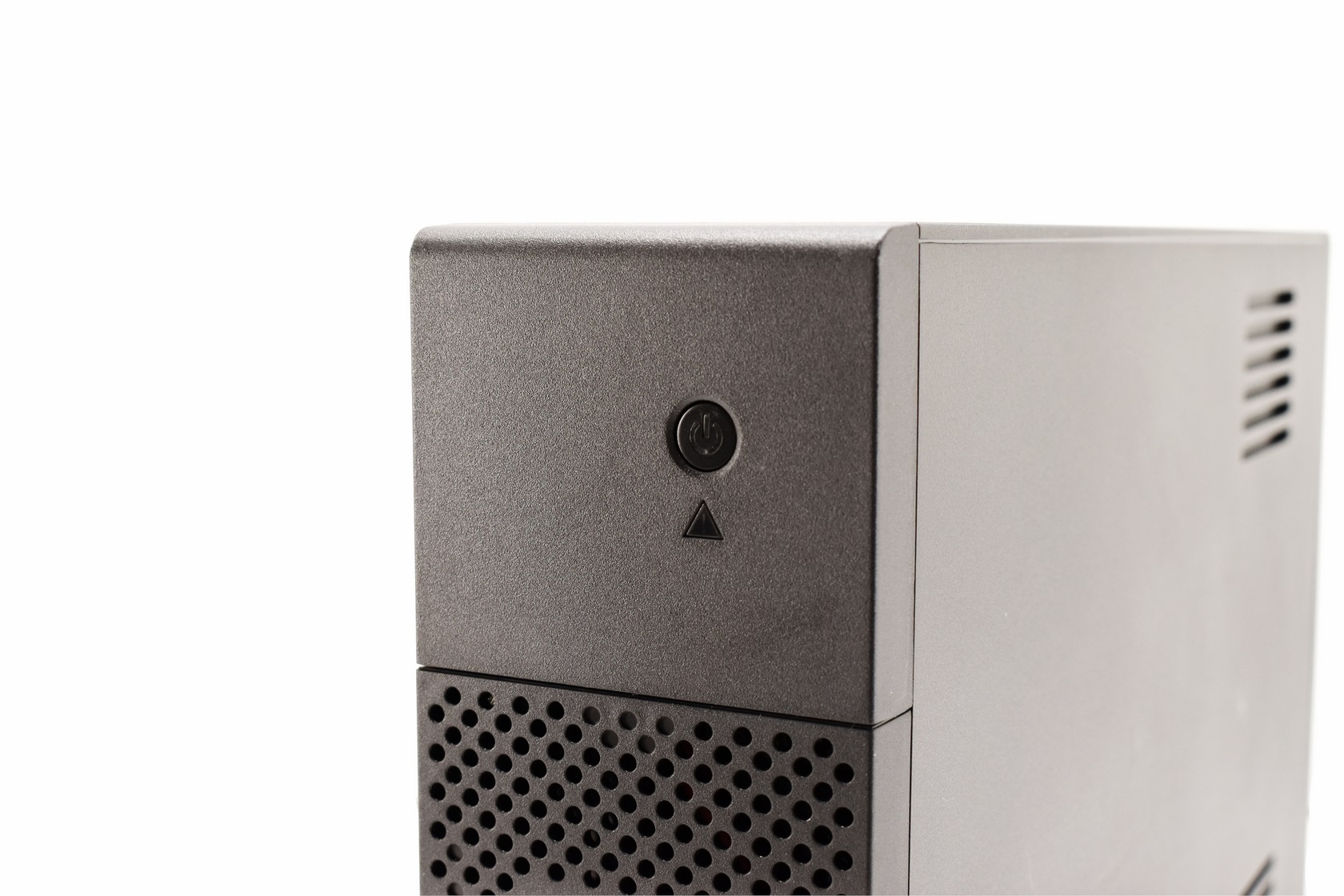
At the front we find the on/off power button with the single activity LED at its center.
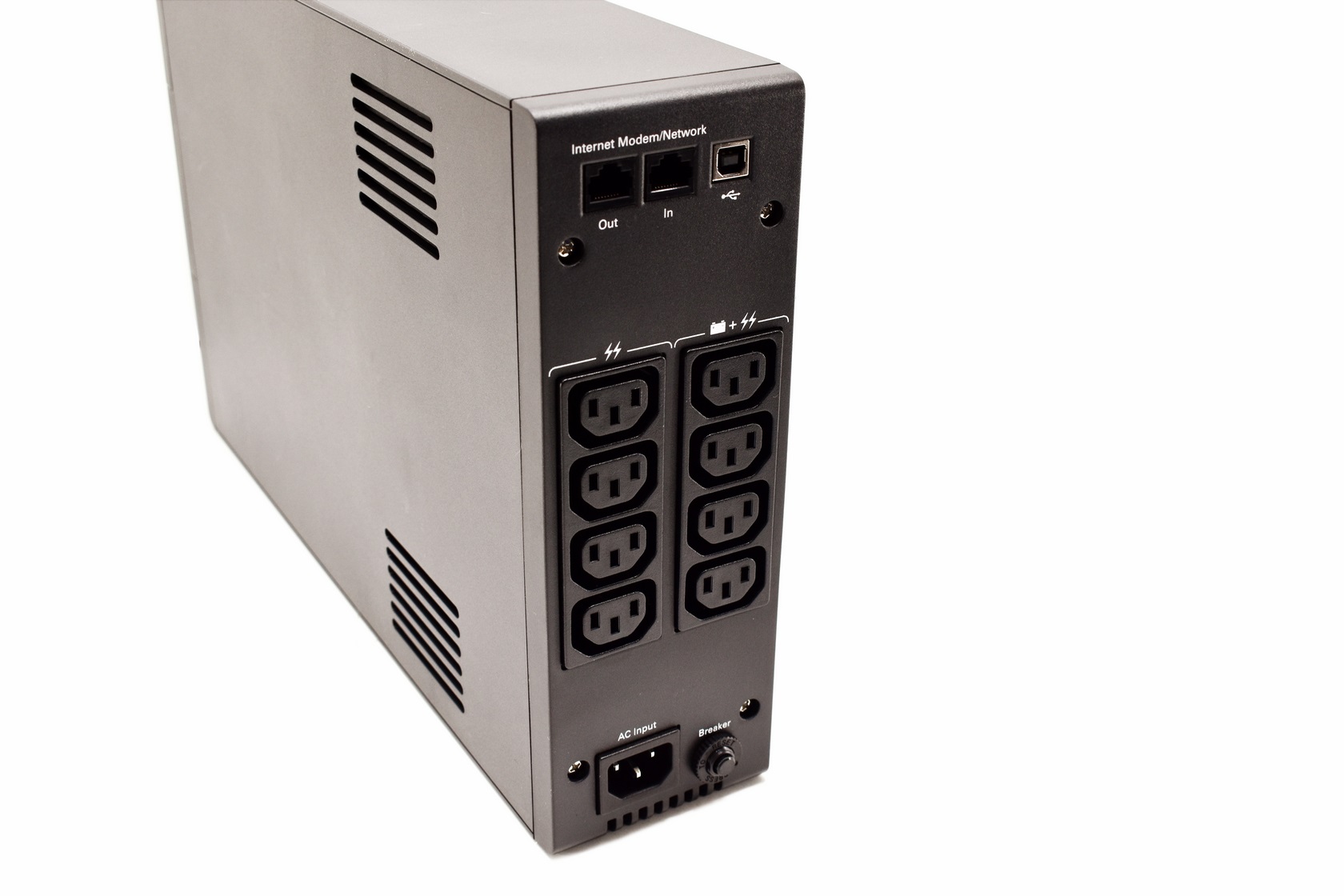
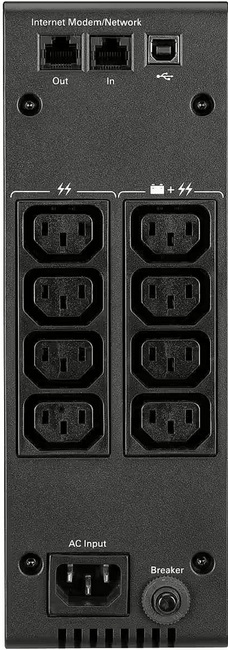
At the rear of the 5S 1500i we find the two RJ11 telephone line ports, USB host port, 8 IEC outlets (left are surge protected while the right ones are battery powered and surge protected), AC input and the breaker button.
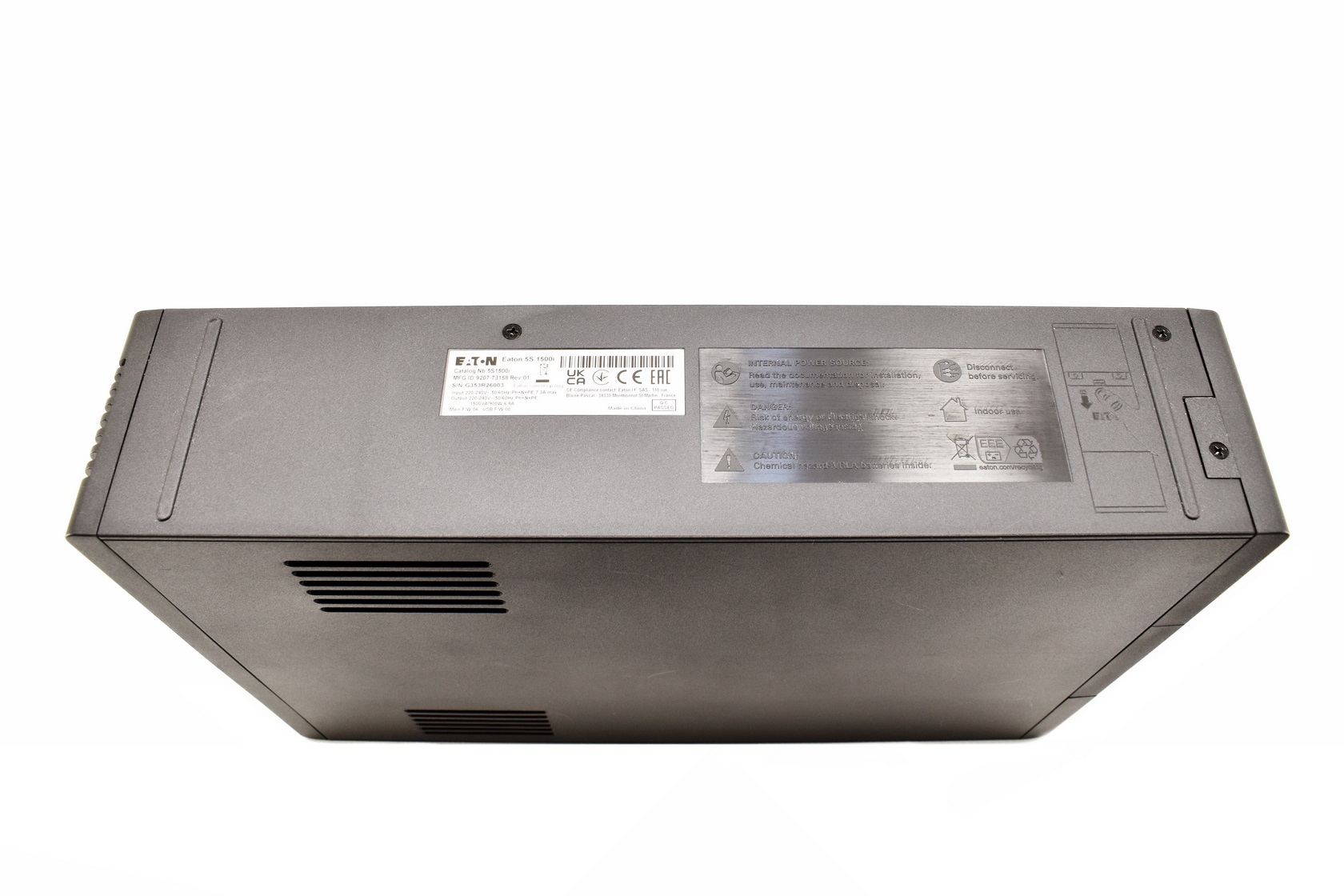
Turning the unit over we find a sticker with the serial number and barcode and instructions on how to access the lead-acid batteries.
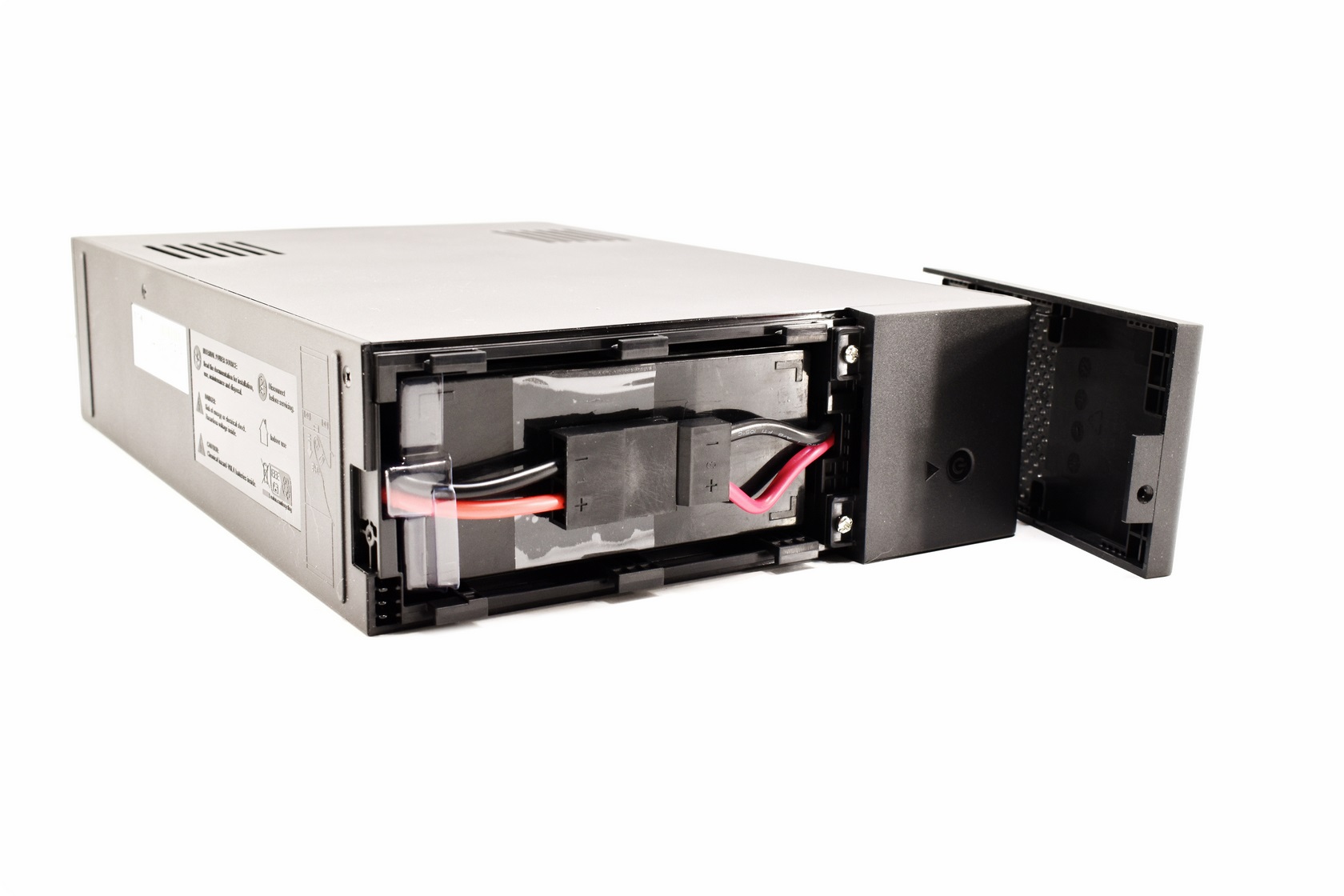
So, to access the batteries you need to remove the screw found at the bottom from and pull the lower fascia downwards.
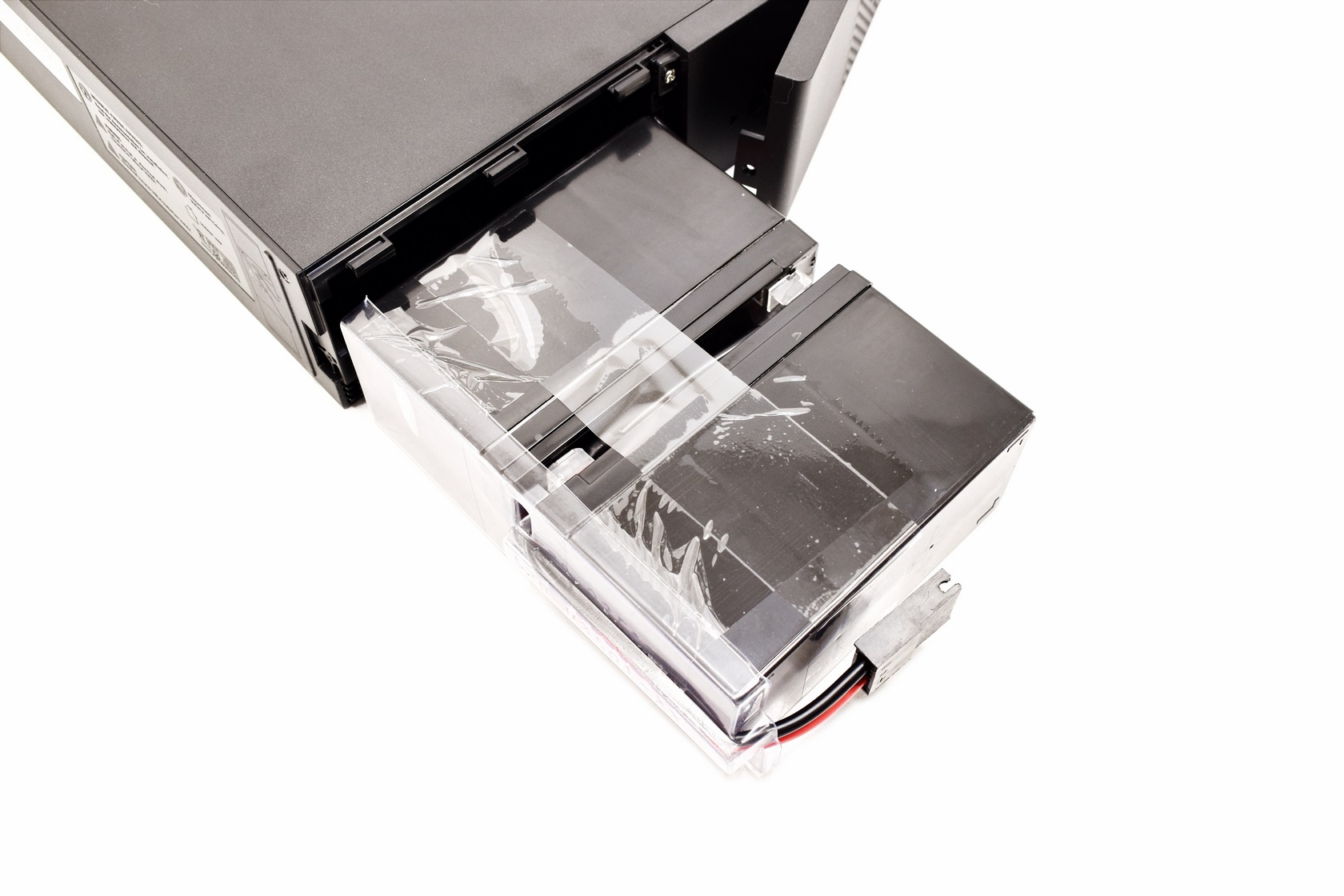
After that just disconnect the connector and slide the batteries out.
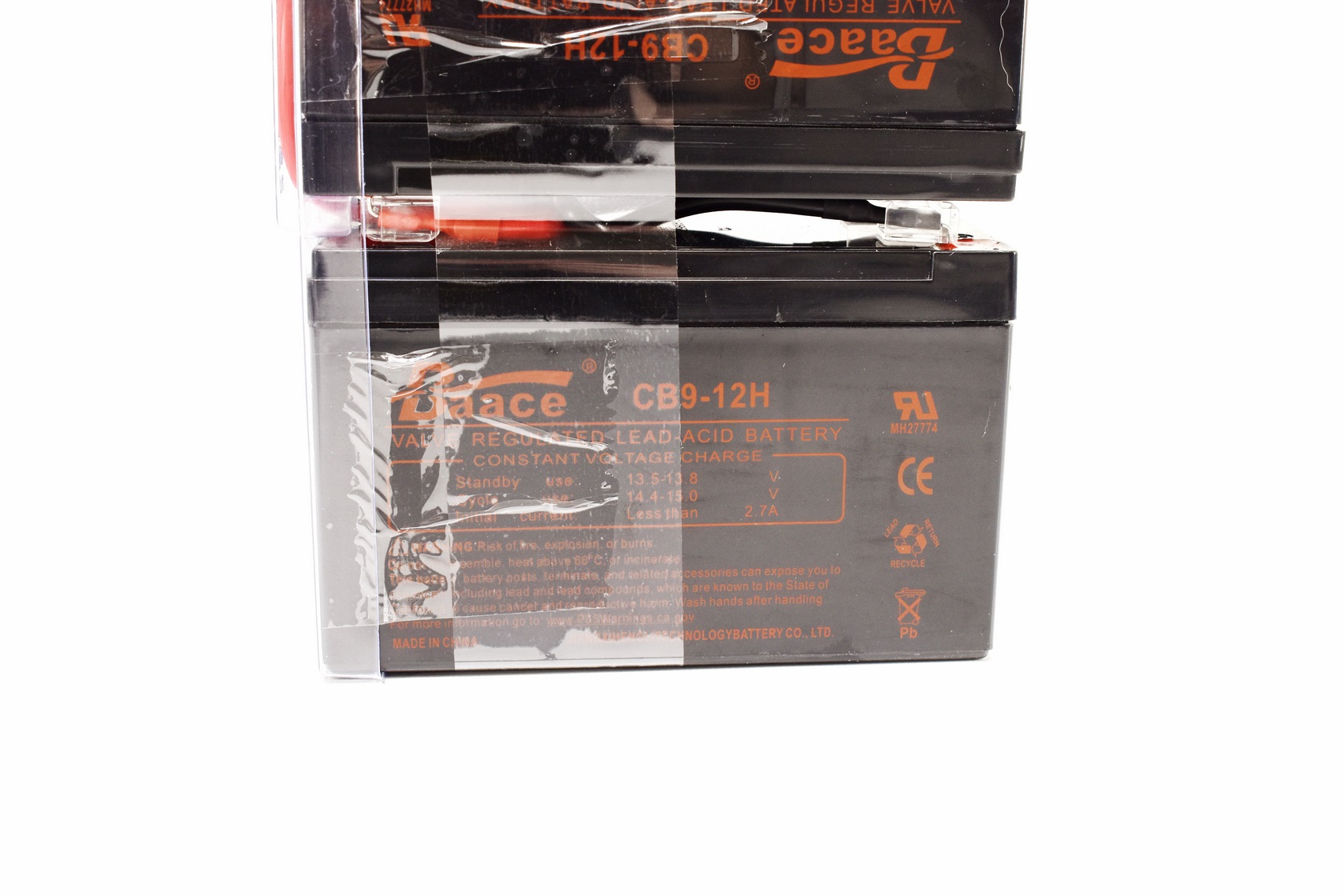
The batteries Eaton is using are manufactured by the Chinese Zhongshan Enduring Battery Co. Ltd (Baace).
UPS COMPANION SOFTWARE
You can download the UPS companion software from the Eaton support page.
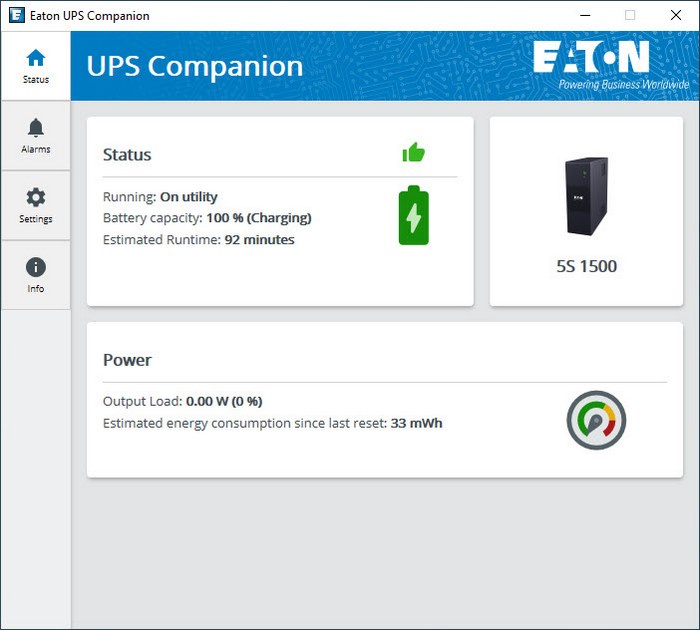
The main tab of the UPS companion software by Eaton lists the UPS model, current battery charge, estimate runtime, output load and estimated energy consumption.
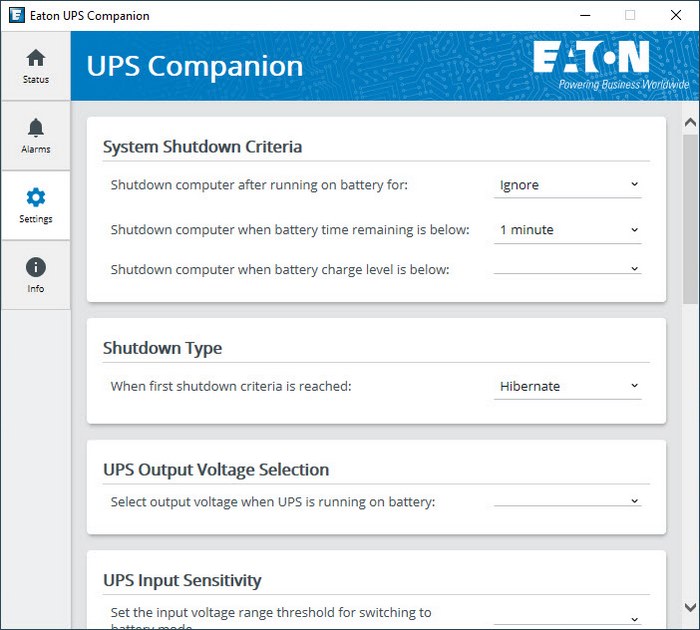
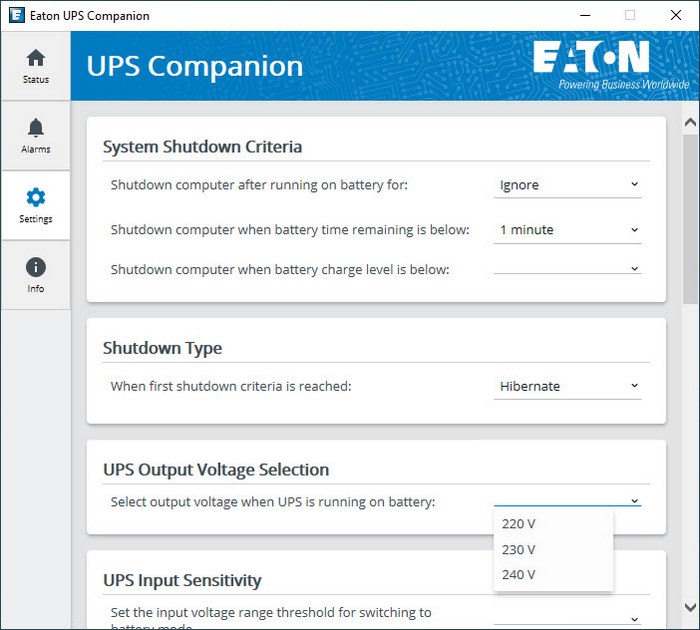
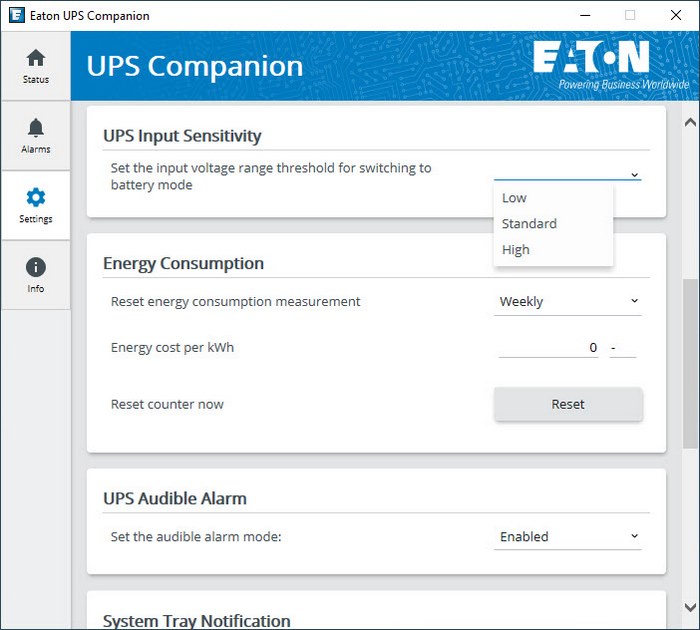
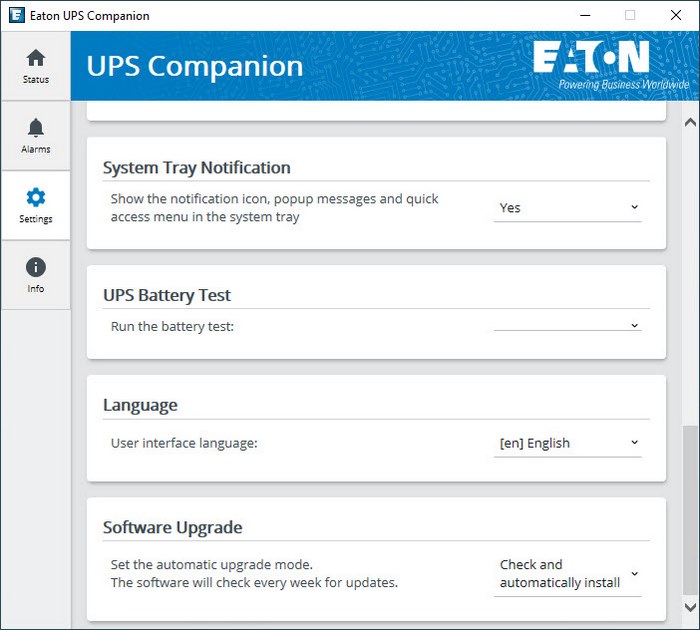
From the settings tab you can adjust shutdown criteria and type, output voltage, sensitivity, energy consumption period, enable/disable audible alarms, test the battery, set battery test intervals and change the language.
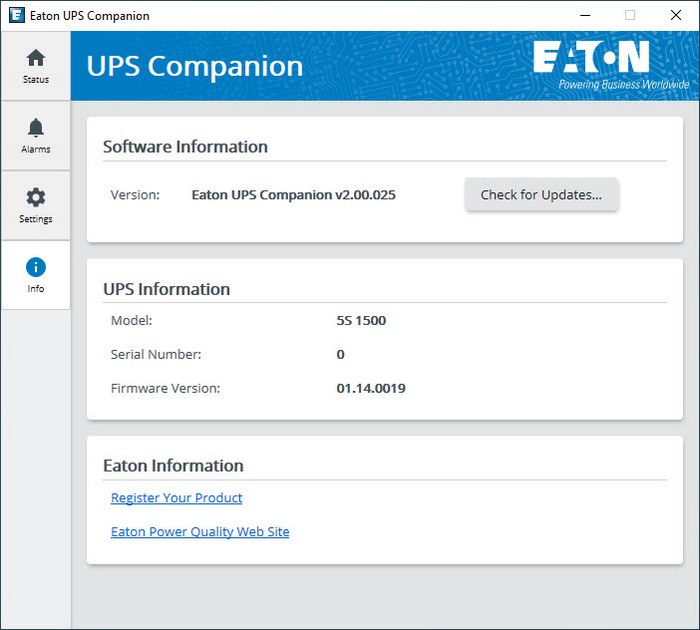
The info tab allows you to check for software updates (same as the settings one), check the firmware version and register your UPS.
TESTING METHODOLOGY
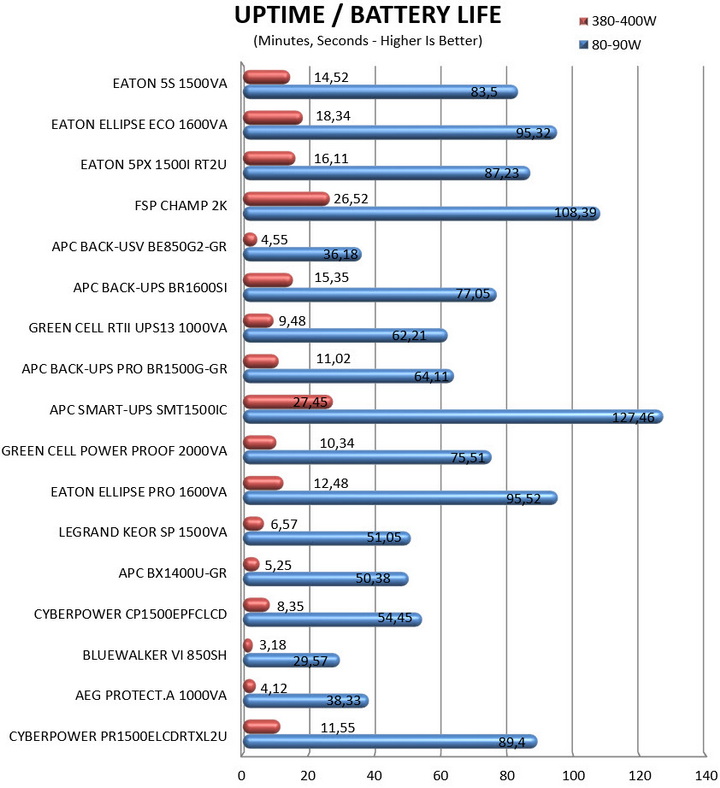
It's been a while since I had a UPS on my test bench and so I decided to slightly tweak my testing methodology. I will again be using a TV set to match the same wattage, but I will also be using a short throw projector model with a media player and even my newest Intel Core Ultra 9 285k test rig (mostly for stability purposes). Once again, power draw is not 100% fixed but the minimum and maximum numbers during all tests don't exceed 10W for the first and 20W for the latter (so do keep this in mind).
To simulate real power outages, I will be turning the corresponding power switch in the lab a total of 5 times (5 for each test), 3 of which I will pushing it back on immediately and 2 which I will allow a couple of minutes to pass. If any of the UPS models I test fail to protect the connected equipment (or fail to keep it running) I will be sure to mention it at the end of the review.
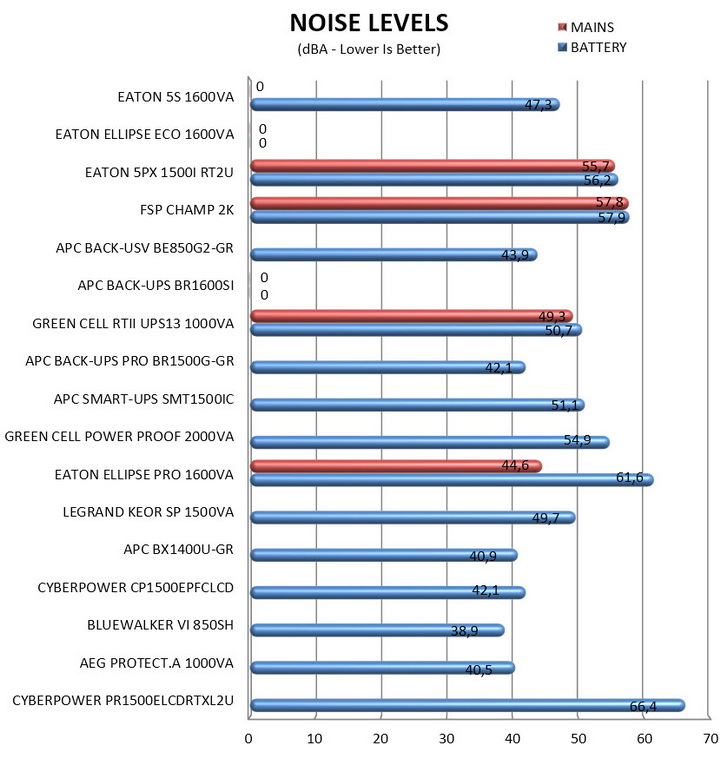
As for noise levels I’ll be using the ExTech HD600 decibel meter placed 5cm away from each UPS model (I will not however be recording beeping sounds coming from their internal speakers).
TEST RESULTS
CONCLUSION
The 5S 1500i may not stand out in terms of design (at least the non-LCD model) but it did extremely well during my tests, regardless of what I threw at it (from my 285k test rig to TVs, projectors, air cleaners, soundbars, dehumidifiers, refrigerators, you name it). Yes, it may not have an LCD screen (again, the non-LCD versions) and lacks some convenient remote features found on more expensive models (or the ELLIPSE ECO/Pro models) but it’s still a very good plug and forget model. The 8 IEC ports out of which only 4 are battery powered is also a convenient feature (must point out that in my case I had to use IEC to Schuko adapters), although it’s one we’ve seen numerous times to date. The plastic enclosure is also not great in quality, quite standard I’d say and well, that’s just fine for a UPS (not that I would complain had Eaton used something better). Initially my sole concern was the Baace lead-acid batteries since I haven’t had much experience with that brand name in the past. Still after over 2 full months of testing without a single issue my concerns were probably unfounded.
Currently the 5S 1500i Line Interactive UPS by Eaton retails for USD400 inside the USA (Amazon.com) and for 321.34Euros inside the EU (Amazon.de) a price tag which is quite balanced for such a model. Overall Eaton has yet another good UPS model in their lineup, yes, it may not compare to some of their higher end models, but it does what it was meant to do well and for that it gets the Golden Award.

PROS
- Very Good Battery Life (Performance)
- Line Interactive Model
- 8 Outlets (4 Battery Powered & Surge Protected / 4 Surge Protected)
- 1500VA/900W
- Electrical Protections
- Low Noise Levels
- UPS Companion Software
CONS
- Price (For Some)
- Non LCD Version