



INTRODUCTION
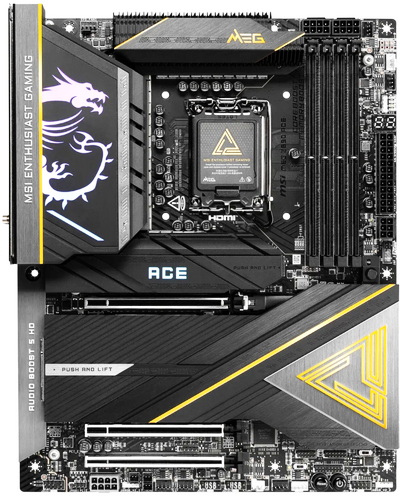
The motherboard remains the central component that defines a system’s capabilities, from CPU compatibility and memory topology to PCIe lane distribution and high‑speed storage support. Stability, power delivery, and thermal performance all hinge on the board’s underlying design. While many options cover the basics, some platforms are engineered with enthusiast‑level headroom in mind. In short, a motherboard isn’t just another PC hardware part, it’s the architecture that everything else depends on. And with all that in mind, today’s review focuses on the MSI MEG Z890 ACE, a board built for users who want a strong platform for high‑end Intel systems.
MSI is a leading provider of hardware solutions for gaming, content creation, and business productivity. Known for its innovation and reliability, MSI develops products that enhance user experience and improve efficiency across a wide range of applications.
MSI’s MEG Z890 ACE stands as a flagship ATX motherboard for Intel’s LGA 1851 platform, built around the Z890 chipset and engineered for extreme overclocking, bandwidth‑heavy workflows, and next‑gen AI‑accelerated systems. It supports Intel Core Ultra 200‑series CPUs with a strong 24‑phase (24+2+1+1) 110A SPS VRM design for stable high‑end performance and four DDR5 DIMMs up to 256 GB, reaching 9200MT/s OC. Expansion is robust with three PCIe x16 slots (2xPCIe5/1xPCIe4) and five M.2 slots (1xGen5/4xGen4), plus four SATA 6Gb/s ports. Connectivity is extremely rich and includes a 10GbE RJ45 LAN via Marvell AQC113, Wi‑Fi 7 + Bluetooth 5.4 via Intel Killer BE200, and rear I/O featuring dual Thunderbolt 4 Type‑C, HDMI 2.1 out, dual USB‑C 10Gbps, and eleven USB‑A 10Gbps ports. Audio is powered by the Realtek ALC4082 codec paired with an ESS ES9219Q DAC, delivering high‑resolution output. Internally, it offers USB‑C 20G with 60W PD, multiple ARGB/RGB headers, and extensive fan/pump headers. Heavy VRM and M.2 heatsinks ensure stability under sustained overclocks, rounding out a board built for creators, enthusiasts, and high‑performance AI rigs.